7.1 A Well-Oiled Operation
In this module, we’ll dive deep into the day-to-day reality of running a mobile market. For new operators, you’re in for a treat as we’ll give you an idea of what to think about and what to expect when deploying your truck for a market run. For seasoned operators, this module will present an opportunity to optimize your current approach to operations by documenting your processes and procedures, future-proofing your market so that it can operate even when you can’t be there.
Whether you’re just getting started as a market operator or have been at it awhile, you’ll get more out of this module by engaging with the community, so we encourage you to dive into the forum and share your ideas, stories, and feedback.
This first lesson is intended to expose you to the people, parts, and processes that make a mobile market run. Click on the arrows to expand and examine each of these elements. We hope the practices listed here provide you with a useful model for assessing the inner workings of your market’s operations.
Vehicle
The operational flow of your organization will be greatly impacted by the type of vehicle you have chosen to use for your market. Operations using a van vs a truck will differ. For example, if you’re using a van, you’ll need to ensure you have tents, tables, coolers, etc… to set up once you arrive at your market location. This will require time and people to load, unpack, and set up/pull down. However, if you’re using a truck, be it a Farmers’ Truck or an alternative, your setup will be much simpler. Your equipment will likely be part of your truck’s components, so your setup is likely limited to opening the doors of your truck and arranging your produce. Your vehicle and the size of your market will dictate how many staff you’ll need to operate your market.
Ensure you have considered and planned for the following:
- A vehicle orientation for drivers, staff, and your volunteers. Anyone who touches the vehicle should be comfortable with all of the operations of the vehicle.
- Pre and post trip procedures should be created and made available for each vehicle in your fleet. (Tip: Create a QR code on paper so that staff can quickly go over the list before they leave for the day and when they return)
- A vehicle maintenance schedule should be outlined and put into the schedule. Vehicle maintenance should be done on a weekly basis:
- Cleaning
- Checking that everything is in working order
- Checking fluid levels (especially if you have a generator)
- Checking tires and lights
- Documenting and training your staff on emergency/break down procedures (eg: who to call, heavy tow needed? Ensure the team knows where the Roadside Safety Kit is and how and when to use it, etc…)
Staffing
To ensure your team functions well, it’s important to define the roles for your entire team (including yourself) based on your operational needs and circumstances.
Ensure you have considered and clarified the following:
- Who’s going to do what:
- Who’s the driver (do you need a specialized driver)?
- Who’s doing the lifting?
- Who’s doing inventory mgmt?
- If you have volunteers, how can you make best use of them? Tip: It’s a good idea to assign volunteers to non-critical aspects of your operation (eg: helping bags, helping customers get the bags to their cars) so that a failure to show does not impact operations.
- How will you manage recruitment? We encourage you to hire from communities that are being served by your market as this approach tends to result in higher employee retention and a deeper social impact.
- What is your compensation model? Paying people is the ideal, but sometimes you need to get creative. In these cases, consider ideas such as offering foodshare as part of compensation.
- What training is needed and how will you deliver it? Typically, training will be needed on safe food handling, produce & produce care, safety training, driving/vehicle training, customer service, POS system, etc… Additional training may be needed on SNAP, de-escalation, diversity and inclusion (D&I), cultural, economic, and age sensitivity training, medical emergency training, and so on…
- How will you onboard new employees? How will you review them and retain them? You should consider how you will establish expectations for your staff and provide opportunities for feedback. It is often helpful to set up a calendar or establish a regular cadence (eg: weekly/monthly) for 1:1 check-ins and exercising active listening.
- What insurance will you need to carry? Most host site agreements will require you to carry liability insurance in addition to vehicle insurance.
What employment regulations do you need to be aware of and abide by? As the mobile market working days often exceed 8 hours, it’s a good idea to familiarize yourself with the laws pertaining to work hours: https://www.dol.gov/general/topic/workhours
Procurement
It will be necessary to evaluate your procurement needs and options within your local food supply chain. When thinking about procurement, ensure you have considered the following:
- What types of food you’ll be selling at your market.
- Will your market sell only local produce? How will you define local?
- Does your organization already purchase food? If not, seek out and develop relationships with growers, producers, and wholesalers. Explain to them what you are doing.
- Be prepared to pay a fair price and use that as an educational tool for your customers and funders. Highlight that your market is contributing to the local economy.
- Will you sell eggs, dried goods, or value-added products? It’s good to have a sense of this before you identify your producers so you can plan out your inventory accordingly.
- Develop your procurement contact database and identify fall back plans (Tip: It’s a good idea to add items to your inventory gradually. Starting with some basics will help you manage customers’ expectations if you suddenly can’t get regular access to an item they’d been enjoying).
- How and who will be picking up or dropping off inventory? What route will the produce be traveling? Who will monitor quality? It helps to document your schedule and explicitly capture your expectations of who will be doing what on which days and times.
- If you are able to work directly with a farmer, schedule a time to discuss your needs while they are crop planning, before they do their purchasing of seeds for the season. The following example of a Crop Projection was developed in conjunction with a farmer to help a busy market with procurement planning: Draft Crop Projections.xlsx
For an in-depth understanding of procurement and marketing, we invite you to visit module 5.
Storage & Inventory
When dealing with goods, particularly perishable goods, it’s important to have a clear plan for storing and caring for the produce. Ensure you have considered the following:
- Where should food go when it arrives at your headquarters?
- How will you implement a FIFO (first in, first out) approach?
- Do you have clearly established guidelines for temperature control and placement?
- Has everyone who handles goods for the market received produce training?
- How will the produce be moved from storage to the vehicle (and then back again at the end of the day)?
- Have you established and documented procedures around:
- Receiving and pickup of products?
- Quality control?
- Loading and unloading produce?
- Pull Sheets are a tool that can help your team pack more effectively. A market manager can determine what will be stocked on the truck that day by using “pull sheets” Example: Pull Sheet Example.xlsx
- Processing and cleaning products?
- If your product needs to be processed (washed, bunched, bagged), consider where and when that will be done. Always have the ability to trim and re-bunch on location at market when needed to avoid product loss.
- Management of food waste, trash, and compost?
- Have a compost and trash bucket on hand at the market.
- Consider giving things away at the end of market rather than having them end up in compost tomorrow (eg: once tomatoes have moved on and off shelves several times and changed temperature, they may be bruised or unable to be sold the next day).
- When your market is getting close to the end, go through your inventory and give away or sell for a steep discount any food that will not last until tomorrow.
- Do you have an outlet for making value-added products from potential food waste? Are there local producers who can benefit from your left over goods that you could work into your operational flow?
- Ensure that all trash/compost is removed from the vehicle each day as part of daily procedures to keep your vehicle clean.
Schedule & Routes
The logistics of running your mobile market can be tricky. You’ll want to ensure you take time to organize your schedule and your routes so that your entire team is clear on the day’s and the week’s commitments.
Ensure you have considered the following:
- Operating markets in similar areas on the same day. This approach avoids your truck having to travel from one end of your service area to the other.
- Determining in advance how long it will typically take to travel from point A to point B, etc… when estimating your start and end times.
- Plan ahead to avoid known times of traffic delays/congestion (eg: rush hour, school bus traffic) wherever possible.
- Identify areas where you think you’ll be filling up your vehicle. Check to ensure there are also bathrooms.
- Provide your team with a print out (map/instructions) for the preferred route to travel, avoiding typical hazards, one-lane bridges, overhead hazards, etc…
- When onboarding new team members who are not locals, travel with them to ensure they become familiar with the region.
- Anticipate and plan around scheduling issues (eg: if Monday is procurement day and it’s a national holiday, ensure you have a plan in place well ahead of that date).
- Develop policies to handle known risks that can impact your market’s operations, such as:
- Weather
- Market Cancelation
- Fires, Threats, Terrorist, etc…
- Incident/Accident Reporting and Process
- Health Emergencies, such as the COVID-19 Pandemics
This list of considerations is intended as a starting point. We highly recommend that you work with your team to brainstorm ideas to identify additional considerations that may impact your ability to set up and operate your market safely.
Operations Calendar
The heart of any well-run market is the operations calendar. You may already have a good handle on what needs to happen and when, but without detailing the expected activities of your market staff in some kind of sharable, visual form (such as a calendar), your operation will likely run in a much less efficient manner.
The following operations calendar gives you a sense of the level of detail to capture to ensure the operation is planned out sufficiently.
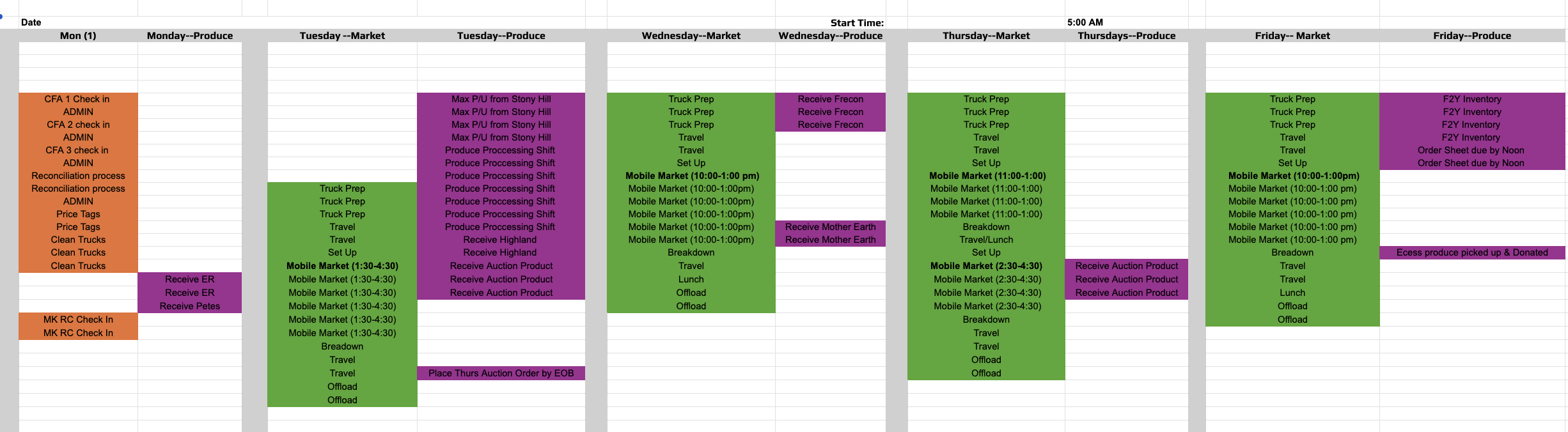
Sample week with produce movement.xlsx
To align the understanding of your staff members, ensure your operation calendar is easily accessible and available to your entire team. Changes to the calendar should be communicated promptly and clearly to the team.
When creating your operations calendar, the following should be considered:
- Truck loading time at warehouse
- Start time for manager vs other staff
- Travel time between markets
- Set up and break down time at market
- Unloading time needed
- What are your plans for extreme weather?
- What are your plans for holidays observed on a market day?
- Will there be a staffing switch in the middle of the day?
- Do you need to account for getting additional inventory on the truck mid-day?
Market Supplies
If produce is the star of the market, then the supplies and the equipment that are used to set up, display, and facilitate transactions could be considered the supporting cast.
To ensure a complete supporting cast of market supplies, you’ll want to consider the following:
- Creating a comprehensive list of market supplies in spreadsheet form to help you track what’s needed and manage your supplies when they begin to run low. Example: Copy of Supply List_2022_2023.xlsx
- Do you need a POS system? If so, which kind?
- What kinds of weather do you need to plan for? Consider the supplies you’ll need for each season (prepare for wind, rain, snow, etc…)
- How will you display pricing? How will you help customers identify unfamiliar food items? Do food tags need to be translated? There are a variety of price displays (these may be chalkboards or on individual tags)? When selecting your price displays, consider weather, durability, and setup time.
- When making purchasing decisions, cheaper isn’t always better. We recommend that you don’t skimp on quality as you’ll end up spending more money replacing cheap tents and other non-durable items in the long run.
Payments & Finances
We’ve already touched on payments a little in the previous section, but here we’ll dive into a bit more detail. To ensure you have a comprehensive plan around accepting payments and managing your finances, consider the following:
- How will you accept payment? What types of payment will you accept? Typical payments will include: cash/credit, SNAP/EBT, double dollar vouchers of some type, Farmers Market Checks, WIC, etc…
- If you need a POS system, what features or functionality will your market need from it? The following provides a comparison of SNAP functionality for POS: https://www.nutritionincentivehub.org/media/ldedekzj/ngaf-pos-matrix-april-2022.pdf
- What processes are needed for each type of payment? Do you have everything you need to process payments at market (eg: a hotspot, ability to process payments offline, a pen for signatures on FMNP checks, etc…)
- Ensure you document your forms of payment, the eligible items and available matching for your team.
- If you have English as a second language staff/volunteers, ensure you translate the payment information in their preferred language. Example: Translated Forms of Payment - Copy of Forms of Payment Training Manual_Recursos de formas de Pago.docx
- Will your market offer online sales? If so, how will the payments and proof of payment be handled?
- Will your market offer SNAP? If so, ensure your team is trained on SNAP procedures. (See: Online SNAP/EBT Guide: https://home.localfoodmarketplace.com/wp-content/uploads/2024/04/final-Guide-Online-SNAPEBT.pdf
When you return from the market, how will you organize your money? Where does it need to go next? Who will be responsible for compiling receipts, checks, and cash, and running the register report? It’s important to document your reconciliation processes to ensure you have a clear process for managing the money received during the market. Example: Reconciliation Processes Copy of SOP_Reconciliation.docx
Licenses, Insurance & Documentation
In module 6, we discussed the policies, permits, and licensing considerations for mobile markets. In order to keep your operations running smoothly, it’s a good idea to make important documents accessible and identifiable to your team. We recommend creating a repository of documents and making them easily searchable and accessible. These documents could include:
- Peddlers license, servsafe, etc.
- Price lists, pack orders
- Maintenance manuals for any/all equipment
- Safety data sheets for cleaning products
- Contacts for the host site, non-emergency police line, emergencies
- Local permit and licenses needed to operate
- Health Department License (needs to be displayed)
- FMNP and SNAP posters should be displayed
A creative idea for making key information available, is to use QR codes that provide your team with quick access to digital versions of the documents. Example QR code that links to a Pre-Trip Checklist:

Promotion/Community Outreach
Rounding out our list is promotion and community outreach. To highlight some of the ways to get the word out, consider the following:
- When thinking about how to best communicate with your customers, consider who your customer base is.
- Does your customer base use social media/? Do they prefer text over email?
- Printed takeaways for customers are an easy win — and don’t forget about your smaller customers. The Farmers’ Truck coloring book can be a fun and educational tool that helps to promote healthy choices and your market.
- Provining flyers and schedules to your community partners to hand out is a great promotional channel.
- Make use of your team’s creativity to devise some enticing incentives or programming to help advertise your market and its value to the community.
- Don’t forget to advertise on the day of the market. Lawn signs indicating where the market will be will catch the eye of passers by. You’ll likely need permission to do this, however. You could even use these when you’re not there indicating when the next market will be held.
- Most customers will either hear about you from someone they know or SEE you. Your market should be visible and appealing, easy to get to, and be fun and welcoming so that people will talk about it and come back with their friends.
For a deep dive on promotion, see Module 5. For community engagement, consult Module 3.
What promotional techniques have you employed? What’s worked well for you? We’d love to hear your ideas.
While we’ve aimed to provide you with a view into a complete operational example of a mobile market, it is possible that we have overlooked some details. If you believe we’ve missed or overlooked something that you feel should be added, please let us know in the comments.