5.2 Supply
Knowing your customers and what they value is key to determining the procurement needs of your mobile market, but running a successful mobile market is not just about being able to provide what your customers want. To build a sustainable mobile market enterprise, you must ensure you are making sound purchasing decisions while also keeping your products moving and your product waste low. In this lesson we’ll discuss the considerations for selecting suppliers. We’ll also provide some ways to create new opportunities through partnership development, and we’ll offer some simple yet impactful strategies for dealing with the challenges of balancing the forces of supply and demand.
Finding and identifying the right suppliers for your market will be front of mind when you are getting started. Keep in mind that your options for suppliers can vary considerably, depending on your market’s location. If you reside in a remote area, your options may be quite limited which could result in the need to rely on one source for the procurement of all your goods. Before you commit to your suppliers, you’ll want to conduct some upfront research to gain a sense of what your options are.
Some of the sources you can consult to gain an understanding of the supplier ecosystem include:
- Local food providers
- Business associations
- Co-operatives
- Local & state food policy councils
- Government directories
To ensure you are making socially responsible decisions about your procurement choices, download our “Social Procurement Scorecard”.
Activity: Use the “Social Procurement Scorecard” checklist sources to rate the suppliers you identified in the first lesson. This will help you determine the producers who may or may not be aligned with the goals of your business.
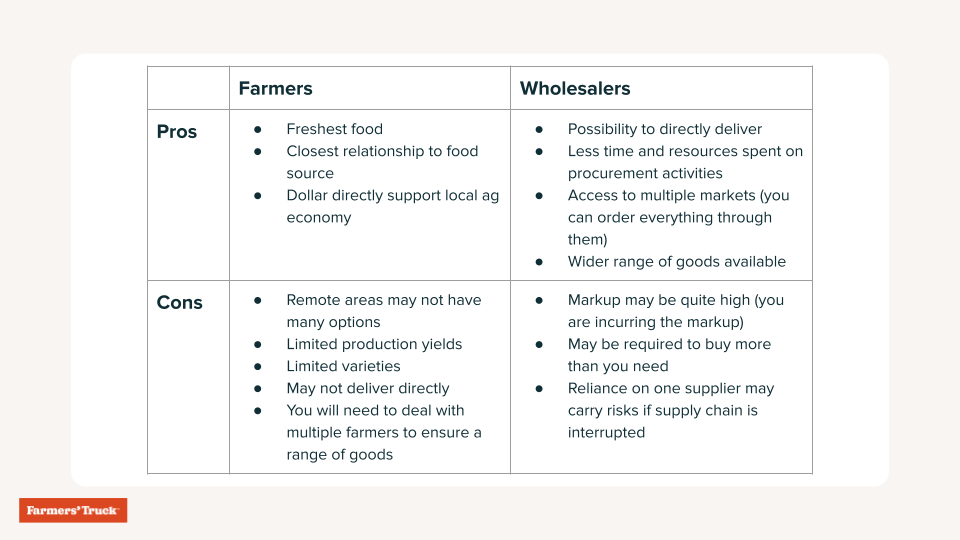
Typically, suppliers can be grouped into two main categories: farmers and wholesalers. For a small mobile market, each supplier will come with its own advantages and disadvantages. Having an awareness of these considerations and constraints will help you make the most appropriate decisions for your market.
In addition to establishing relationships with farmers and wholesalers, developing a partnership with your local grocery store can provide you with opportunities to access volume pricing without having to commit to high volumes. These types of partnerships can be highly beneficial for both the store and your mobile market, as your market will be able to service customers that the local store can not. This type of partnership can also help the store with extending their reach into the community. Proposing formal sponsorships in which the grocery store subsidizes your products to help feed a certain number of households in the local community is another idea to create a win-win scenario for both enterprises.
A Cautionary Note: When partnering with grocery store chains, ensure you have the approval of the right corporate officers in writing, noting any limitations or restrictions that might be attached to the relationship.
Developing Local Partnerships: Gaining an understanding of the availability of socially-minded businesses and associations in your community can create new opportunities for networking and collaboration. Some ideas that you may wish to consider include sponsorship opportunities with community gardens and partnerships that include group purchasing by food banks. Learning how to weave yourself and your market into the community network can take some time, but reaching out to your local community hubs is a great way to get started.
Tales from the Road
One of our favorite suppliers is a local honey producer. Our relationship is one that’s built on common goals and aligned values. At the beginning of each season, we buy a few dozen cases of honey in bulk for an excellent price point due to our ongoing partnership. This allows us to pass the cost savings on to our customers by offering great honey at an accessible price.
After learning that the honey had become a big hit at the local Veterans hospital where we were set up, we happily shared this with the producer. It was a unique environment. Many of the vets resident at the hospital had access to a group kitchen, but they had no knives for prepping many of the veggies. So, the vets would purchase honey and hand fruit to create a sweet snack on the go. The snack soon became a community favorite, with the honey being the star of the show. It was such a success that we had to reorder midway through the season!
Given the vet’s affinity for the honey, we invited the good folks from the honey company to visit our market to deliver the honey in person — and they were more than happy to accept. It made for a great community-building moment that we won’t forget: the honey folks sitting around a table with the vets and our team, tasting some samples, talking bees, and sharing some interesting and humorous honey stories.
When making purchasing decisions, it will be vital to be aware of the shelf-life of your goods and the best practices for storage and display. Remember, your goods are perishable! Many of the challenges associated with perishable goods, however, can be avoided just by maintaining the right volume. If you move enough products the ticking clock won’t be as much of a concern.
Of course, you won’t be able to strike the right balance all the time. Shifts in your customers’ buying habits, market fluctuations, Mother Nature, volume discounts that you couldn’t pass up, or new products that didn’t have the uptake you’d hoped for, can all have an impact on your ability to strike the right balance. These unforeseen challenges can leave your mobile market with more or less supply than you had intended, and when this occurs, there’s only one thing to do: hustle!
Knowing the shelf-life of your product and the behaviors of your customers will help you prioritize what needs to move fastest. Use this handy resource from the University of Maine to monitor the shelf life of your produce.
Remember, your goal is to move your products and empty the containers so that you aren’t transporting merchandize back to homebase. Here are some ideas you may want to try:
- Deal of the Day: If your products aren’t moving as you’d expected, reframe them. Move them to a more central location in your stall and highlight them as “The Deal of the Day”.
- Did you know?: If you’re having trouble moving a relatively new product or one isn’t typically that popular, highlight something new about it. As an example: Do you know that the avocado is a nutrient-dense superfood that makes a great meal for infants and children on the go. Serve them as a baby food puree, mashed, or as finger food!
- Lower the price: Lower your price and make sure you advertise and promote the discount.
- Strategic pairing: If you’ve got a product that sells quickly and can be easily paired with one that is more difficult to move, promote the pairing and offer a discount for the pair.
- Meal suggestions: Be ready to talk to your customers about the versatility of your products. For produce that you need to move, engage your customers with some ideas on how to use and store them.
- Reorder Display: Simply spruce up the display, spritz some water on the greens, clean off a wilted protective leaf, and move front and center to entice the shopper
As you can see, there are many creative ideas that can be used to master the hustle. In a recent interview with The Farmer’s Truck, Pete Luckett shared his advice on moving products, drawing customers in, and creating a feeling of abundance.
We’re pleased share some of Pete’s insights with you:

Pete was the founder of Pete’s Frootique, a nationally recognized and award winning market based in Nova Scotia, Canada. Pete became a local celebrity who was known for his enthusiasm, knowledge, charisma, and focus on customers, quality, and food presentation.