3.1 The Importance of Community Engagement
In this module, we’ll take a deep dive into the subject of community engagement, what this can look like, and what it can mean for your mobile market. In addition, we’ll introduce you to some tools that you can use to support your community engagement work, with particular focus on community asset mapping -– a practical community-based research framework that can help you gain deep insights into the nature and needs of your community.
We’ll begin by defining what we mean by community engagement and why we believe it is the key to creating a successful mobile market venture that balances financial sustainability with social impact.
For a definition of community engagement, we’ll borrow one from Penn State’s Department of Agricultural Economics, Sociology, and Education. The university describes community engagement as an act of engaging with a community “in order to achieve long-term and sustainable outcomes, processes, relationships, discourse, decision-making, or implementation.” (ref: What is Community Engagement? — Research — Department of Agricultural Economics, Sociology, and Education)
We like this definition because it calls out the many layers and dimensions of communities –– the outcomes, the processes, the relationships, etc…For a mobile market wanting to deeply engage with their community, the actions of engagement need to be understood as multi-dimensional, requiring a range of behaviors such as inquiry, sharing, helping, and active listening on the part of the mobile market team.
Now that we have a definition to work with, there are many ways to consider how community engagement can or should be approached. For us, at the Farmer’s Truck, and for many of our collaborators and partners, the “by the community, for the community” approach resonates most powerfully. With its roots in educational philosophy, the “by the community, for the community” approach is a participatory process that seeks to raise up the voices of marginalized individuals and groups in order to help them gain greater control over their lives and environment. (ref: Maton, 2008)
To give you a sense of what this type engagement looks like, we’ve provided some examples:
- Community Engagement – FRESHFARM
- https://www.hungercenter.org/wp-content/uploads/2015/07/HFCR_Chicago_IL_2015_Inwald.pdf
- https://www.aecf.org/blog/food-banks-demonstrate-the-power-of-community-engagement-for-results
- https://www.foodsystemsjournal.org/index.php/fsj/article/view/367/351
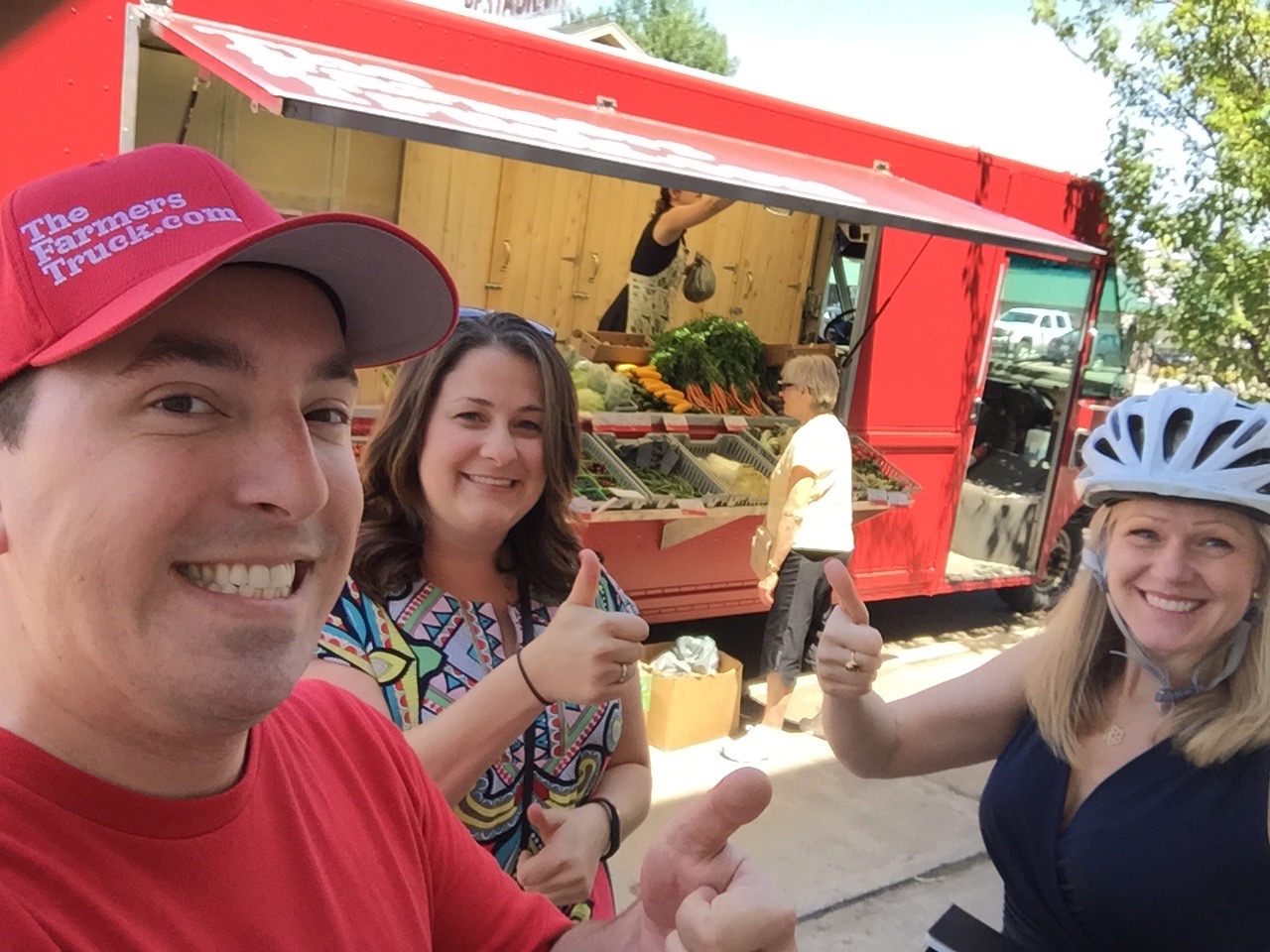
In most cases, the focus of community engagement for a mobile market is to understand the needs of marginalized and underserved communities in order to create solutions. Through products and initiatives that respond directly to the needs of the community, mobile markets can truly make the biggest impact and positively influence the health outcomes of its community members. By making nutritious food accessible, by modeling a variety of healthy choices, and by creating positive conversations around food, a mobile market can be a powerful instrument of change.
Yet, in thinking about your market as a business venture that must balance social profit with financial profit in order to become and remain sustainable, we encourage you to think broadly about the kinds of community engagement activities that can help you achieve your market’s objectives.
If you have adopted a Robin Hood model (or something similar) and have identified corporate partners to service as a complement to your market stops, you will want to ensure you get to know the needs, wants, and challenges of this community too. While this community will likely not face the same kinds of barriers in accessing healthy food choices, their needs are nevertheless important to understand and –– as far as they align with your business’s goals –– to attend to.
A corporation’s human resources team can be a great partner to work with to understand this community’s needs. They can also provide information (and influence) to support and and promote your offerings such as wellness programs or employee satisfaction initiatives (eg: food tastings or skills demos).
A final note about approaching community engagement which might be difficult to hear. That is, not all communities can or should be serviced. What we mean by this is:
- a mobile market may not work for every community, and
- it is not always financially sensible to service every community
If you’re motivated to jump right in, we’re happy to hear it! But before you do, we’d like you to give some thought about how to best prepare yourself and your team for engaging with communities in a meaningful way.
A high degree of emotional intelligence and a great deal of time and dedication will be required to initiate (and sustain) dialogue and gain trust with a community. This can not be stressed enough. Engaging with your communities is time-intensive and it should be an ongoing part of your work throughout the year –– not just a one-off task/project.
To help you start things off on the right foot, we’d like to share some Principles of Community Engagement. These principles, of which there are nine, were published by the CDC, but they have broad usage and can serve as a checklist for ensuring your venture is moving forward with community engagement in the right way